
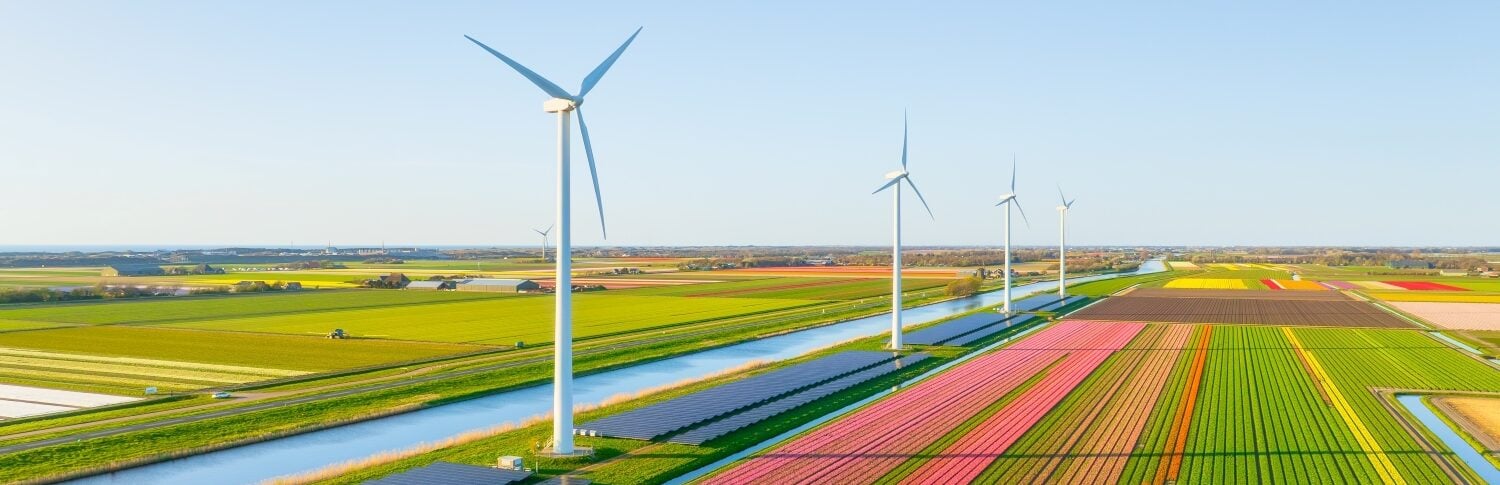
The energy transition brings legal questions for entrepreneurs, farmers, property owners and project developers. What permission is required for a solar park, energy hub, wind turbine, battery or installation for heat and cold storage (WKO)? What does grid congestion mean for a project? And what obligations apply for energy savings? The lawyers of Schenkeveld Advocaten help you assess the public and contractual consequences in context.
Energy law concerns the rules and agreements regarding the generation, storage, saving, delivery and infrastructure of energy. It includes the Environmental Code, permits, grid connections, subsidy schemes, land use and agreements.
Legal advice on energy projects
An energy project requires more than just a technical solution. The location, the environmental plan, any permit and reporting requirements, available grid capacity, and agreements with relevant parties influence what is possible and when the project can be carried out. We advise on the legal issues involved and assist clients in negotiations with governments and other stakeholders, and where necessary in appeal, disciplinary, or contractual procedures.
When dealing with energy-related issues, we work together with our specialists in agricultural law, real estate law, corporate law and public law where necessary.

“As companies are forced to anticipate developments in the energy sector, the need for legal assistance is growing.”
Permits for renewable energy and energy storage
Do you want to build a solar park, energy hub, wind turbine, battery, charging facility or WKO installation? Then the regulations that apply at the location and whether an environmental permit, notification or other approval is required must be assessed per project. Nature, the environment, safety, landscape integration and provincial or municipal regulations also play a role. Not every project follows the same procedure.
For projects that do not fit within the environmental plan, a change to the environmental plan or a permit for an off-plan environmental plan activity may be considered. In granting that permit, factors such as the balanced allocation of functions to locations play a role. Timely assessment of the spatial and legal prerequisites helps to make bottlenecks in planning visible.
Network congestion and transport capacity
Limited capacity on the electricity grid can slow down the connection or use of transport capacity. This can have consequences for business expansion, electrification, housing development, industrial areas, and new energy projects. A granted environmental permit in itself does not mean that a grid connection or sufficient transport capacity is available. This can have consequences for the feasibility of your project and the permit.
We assess the legal position of the parties involved, the existing agreements with the network operator, and the consequences of delays for permits, contracts, and project planning. Possible technical or contractual alternatives, such as a different phasing or flexibility in energy consumption, always require an assessment of the specific situation.
Energy savings: what obligations apply to your company?
For energy savings, not only the Environmental Activities Decision (Bal) is relevant. For building-related measures, the Building Works Environmental Decision (Bbl) also applies. The Bal contains the rules for environmentally harmful activities. The Bbl includes, among other things, rules for measures related to the use functions of buildings. The obligation, insofar as the regulation applies, does not exclusively relate to energy savings: certain measures for renewable energy and the replacement of an energy carrier may also fall under this category. According to the relevant provisions, the payback period is not to exceed five years (Bal, Article 5.15; Bbl, Article 3.84).
An important starting point is the annual energy consumption. The relevant provisions provide for an exception when the consumption is less than 50,000 kWh of electricity and less than 25,000 m³ of natural gas equivalent. Furthermore, whether the obligation actually applies depends on the activity or use function and the other application conditions and exceptions (Bal, Article 5.15; Bbl, Article 3.84).
Those who fall under the applicable regulations must also provide data on the measures taken. Furthermore, certain large consumers are subject to an obligation to report. The reporting obligations are regulated in the Bal and the Bbl; the obligation to report the energy consumption of environmentally harmful activities is set out in the Bal (Bal, Articles 5.15a and 5.15b; Bbl, Article 3.84a). In the assessment, the approved lists of measures and the specific circumstances of the company or building may be relevant.
Monitoring, enforcement and tailor-made solutions
If a company fails to comply with an applicable energy saving or reporting obligation, the competent authority may take enforcement action. The appropriate and possible measure depends on the violation and the applicable regulations. A penalty under threat of fines may be involved in this case. The question of whether customization is possible also requires an assessment of the situation.
Have you received a notice of inspection, an enforcement intention or an enforcement decision? Then we assess which obligation has been breached by the competent authority, whether that obligation applies in your situation and which response or procedure is appropriate.
Energy projects on agricultural land
With a solar park, energy hub, wind turbine, battery or other energy supply on agricultural land, public and private law issues come together. These include the environmental plan, provincial regulations, nature and landscape interests, the grid connection and the existing agricultural use. In addition, the landowner and the initiator must make agreements regarding access, construction, operation, maintenance, liability and the end of the project.
Depending on the chosen structure, rent, ground lease or a lien may play a role. We help assess and document these agreements and handle the procedures for the necessary decisions.
Climate, water and soil in the physical living environment
The energy transition is not separate from other choices for the physical living environment. Plans for energy generation or business expansion are intertwined with interests in the areas of nature, water, soil, and spatial quality. Environmental visions, programs, the environmental plan, and provincial regulations can influence the location and feasibility of a project. We map out the relevant decisions and interests and advise on the legal options.
What can our lawyers do for you?
We can assist you with, among other things:
- the assessment of permits, notifications and other approvals for energy projects;
- issues surrounding network congestion, connectivity, transport capacity and existing agreements;
- the energy saving obligation, information obligation, research obligation and enforcement;
- the assessment of the conditions of applicable subsidy schemes and decisions regarding them;
- agreements on land use, real estate, operation, energy supply and WKO;
- participation and consultation with residents and authorities;
- Objections, appeals and contractual disputes.
Would you like to know which rules or agreements are relevant to your situation? Contact our lawyers.
Contact
Do you have a question about energy savings, an energy project or grid congestion? Contact our energy law lawyers.
The most frequently asked questions
What is energy law?
Energy law covers legal questions regarding the generation, storage, saving, delivery and infrastructure of energy. Depending on the project, environmental law, subsidy law, agricultural law and contract law are also relevant.
When does the energy saving obligation apply to my company?
That depends on the environmentally harmful activity or the use function of the building, the annual energy consumption, and the statutory exceptions. The threshold provisions distinguish between a consumption of less than 50,000 kWh of electricity and less than 25,000 m³ of natural gas equivalent, and situations in which that exception does not apply. In this case, it must be assessed whether the relevant rule applies to your activity or building (Bal, article 5.15; Bbl, article 3.84).
What can I do if congestion is slowing down my project?
First, map out which connection and transport capacity has been requested or agreed upon and what the network operator has communicated about it. Then assess the consequences for permits, contracts, financing, and planning. Which next step is meaningful depends on those documents and the actual capabilities at the location.
Do I need a permit for a solar park, energy hub or battery?
That depends on the location, the size and implementation of the project, and the regulations that apply. The environmental plan, environmental regulations, safety, and natural resources can all play a role. Therefore, first assess whether a permit, notification, or other approval is required.
When is participation by residents mandatory?
When applying for an environmental permit, it must be stated whether participation has taken place. If this has happened, the applicant must provide information about it (Omgevingsregeling, article 7.4). The municipal council can designate cases in which participation is mandatory prior to applying for an external environmental plan activity. Whether such an indication applies to your project must be determined locally.
Which agreements are important in an energy project based on another agreement?
In any case, record who is allowed to use the land, for which installations, for how long and under what conditions. Access, maintenance, liability, termination and removal of installations also deserve attention in this regard. The appropriate legal form depends on the project and the position of the land owner and the type of installation.


Related articles
-
Get the hang of it with the Article 96 Rv procedure!
Read full message: Hak samen de knoop door met de artikel 96 Rv-procedure!Primarily for parties that work together on a long-term basis and want to continue to work together, the Article 96 Rv procedure offers opportunities. This procedure gives parties the possibility to jointly present a dispute to an independent judge in an accessible manner. The parties act jointly, rather than being pitted against each other in the procedure. How…
-
Food prices 2027: statutory indexation increases by 4.1% as of 1 January
Read full message: Alimentatie 2027: wettelijke indexering stijgt met 4,1% per 1 januariDo you pay or receive alimony? Every year, alimony amounts (both child support and spousal support) are adjusted based on the statutory indexation. For 2027, the indexation has been set at 4.1%. Mandatory annual indexation The indexation applies to both alimony established by a court (for example, through a court judgment) and alimony agreed upon mutually. It is…
-
Municipality cannot attribute land sales to the desired buyer
Read full message: Gemeente mag grondverkoop niet toeschrijven naar gewenste koperIntroduction The municipality of Dronten wants to sell a plot of land of 9,000 m² for the expansion of the establishment of migrant workers, to the only serious bidder in its opinion. By selling the land, the municipality also meets another policy objective, namely reducing student housing in Dronten-Noord. The intended buyer owns seventeen student housing units. In exchange…